
Sony's $60 Walkman headphones: worth it in a world of earbuds?
Most people now listen with wireless earbuds: charge a case, wait for a pair to connect, hope the battery lasts the trip home. Sony is selling a much older idea for $59.99: a light, wired on-ear set that you plug into a USB-C phone or laptop and just use. No battery, no app, no pairing screen.
The twist is in the small print. The MDR-3R looks like the headphones that came with the first Walkman in 1979, but Sony itself says not to use them with a Walkman. They will not block a busy street, and people nearby may hear your music. So is a $60 plug-in pair still a smart everyday buy, or mainly a nostalgia object?
Quick take. These are open on-ears, about 38 g without the cable, with a USB-C plug and a three-button remote for calls, volume and playback. Reviewers who have worn a pair like the comfort and the clear vocals in a quiet room. They are a weak choice for a loud commute, for private listening, or for any device that only has a headphone jack. If you want the same light on-ear feel and a 3.5 mm plug, the long-running Koss Porta Pro, listed at $49.99, is the closer match. We have not tested a review pair of our own.
What they're like on a normal day
Picture a morning at the kitchen table, a quiet office, or an evening on the sofa. You want music or a show without a setup ritual. You plug the lead in, and the job ends there. The Verge's review describes the same appeal: the set is so light it is easy to forget you are wearing it, and vocals stay clear.
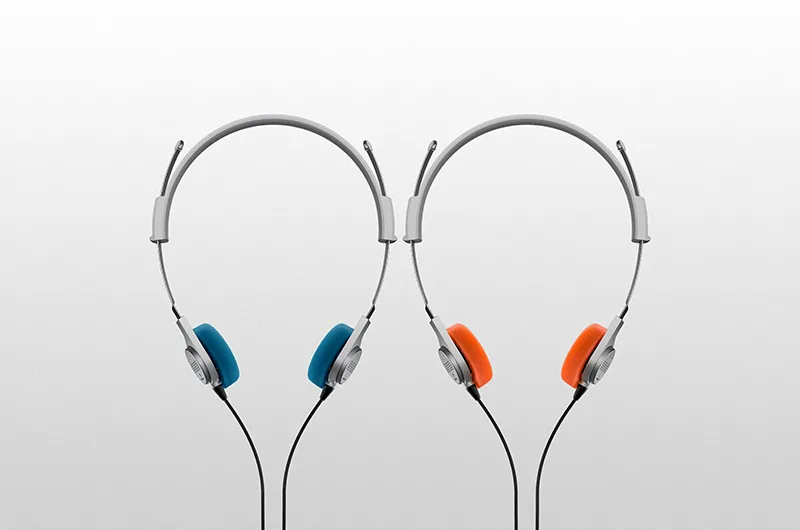
The cups sit on the ear, not around it, and they are open at the back. You will still hear the kettle, a colleague, or a doorbell. That can be a plus at home, and a minus on a bus. Sony has told What Hi-Fi there is "some sound leakage." The Verge's writer turned the volume up on a walk just to hear the music over traffic, and still would not use the pair to shut the world out.
A cheap jack-to-USB-C adaptor will not help if your device has no USB-C port, because the headphones themselves are a USB audio device. SoundGuys could not get a pair working with a Samsung Galaxy S24 even though that phone has USB-C, so test with your own device first.
The Walkman catch
The shape points back to the on-ears bundled with the original Walkman TPS-L2. This is a new product, not leftover parts from that era. Sony says the 23 mm drivers were built again from the original specifications, then given some extra tuning for music people play now. Some write-ups have called them "drivers from 1981." Sony's own wording is narrower than that.
The cable ends in USB-C, not a 3.5 mm plug. A vintage cassette Walkman cannot use them at all. A modern Walkman, which usually has a headphone jack, is also a poor match. Sony's US announcement says use with a Walkman is not recommended. SoundGuys looked at the support wording: volume can fail to change, or can stick high, and some sound settings and the inline remote may not work. If you actually listen on a Walkman, buy a 3.5 mm pair instead.
That launch news was the hook on r/gadgets this week, via Notebookcheck's report. We could not load the live comment thread while writing this, so we are not quoting it. Reviews keep returning to the same questions: USB-C only, sound leak, and whether $60 is a fair price.
How they compare
For the same kind of light, open, on-ear sit, the Koss Porta Pro has been the usual recommendation for years. Koss lists it at $49.99. It uses a regular 3.5 mm plug, so it will connect to a Walkman, an older laptop, or a plane socket with a simple adaptor. It will also leak sound, because it is an open design too. SoundGuys argues that this style of headphone has belonged to the Porta Pro for a long time, and that the MDR-3R is comparatively pricey for what it does.
Wireless earbuds are the other everyday alternative. They need charging, and many of them seal the ear — which is what some people want on a commute, and what others are trying to avoid. The MDR-3R will not compete with a noise-cancelling over-ear on a plane. That is a different job, and a different price.
Should you buy them?
Buy them if you want a very light wired pair, your device has USB-C and actually works with USB headphones, you listen mostly in a fairly quiet place, and $60 feels fair for something you will not have to charge. If the 1979 look is part of the pleasure, go in with your eyes open.
Skip them, or try them in a shop first, if you need silence, often listen at a volume that should stay private, hoped to use them on a Walkman or a headphone jack, or want the same shape for less money and a more flexible plug.
A limited Stranger Things version is listed at $79.99 in the US. The standard pair was announced at Sony, Amazon, Best Buy and other authorised sellers; in Canada it is $99.99. Japan's official store has it on pre-order, on sale 20 November 2026.
We have not tested a review pair, so treat Sony's sound claims as the company's goal. The Verge and SoundGuys, who have, both like the comfort. Neither pretends these are a closed-back commuter pair, and SoundGuys is less convinced they are the best use of $60.
Verdict. Buy the MDR-3R if you want a simple USB-C desk or home pair and you like the look. If you need a jack, a quieter cup, or more flexibility for the money, look at a 3.5 mm on-ear such as the Porta Pro, or stay with the earbuds you already charge.
A little more detail
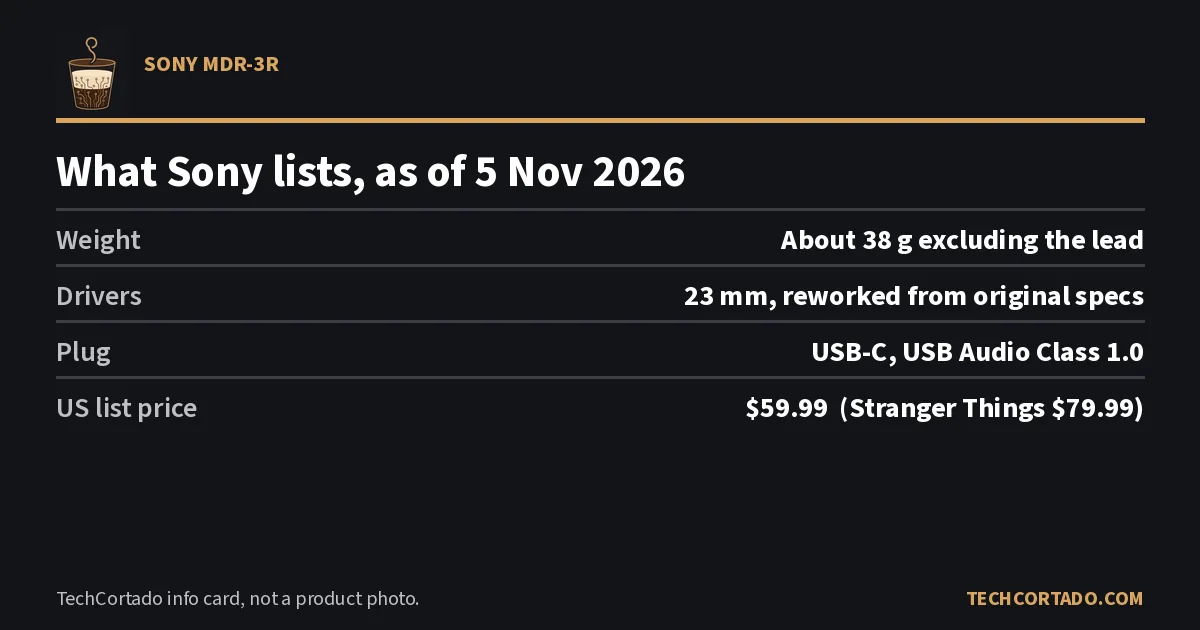
Sony lists the set at about 38 g with the cable left off the scale, and calls it the lightest headband model in its current line-up as of November 2026. The Japanese specification sheet lists an open-air design, 23 mm drivers, a neodymium magnet, and a 1.2 m Y-shaped cable. A microphone and a three-button remote sit on the lead. The host needs to support USB Audio Class 1.0, and a phone or app may ask you to change a setting. Ecoustics reported a 16-bit/48 kHz converter in the cable, and a straightforward connection on a Windows PC, Mac, iPad, a Galaxy phone, an iPhone and a Chromebook.
There is no official water-resistance rating and no noise cancelling, because there is no on-board battery to run it. The standard pair includes blue and orange foam pads so you can swap the colour.
Price snapshot
We checked these pages on 11 November 2026. Shelf prices move, and tax or shipping may sit on top.
| Region | Store | Price on 11 Nov 2026 |
|---|---|---|
| United States | Sony official list price | $59.99 |
| Europe | Sony Centre UK (authorised retailer) | £49.00, pre-order |
| Asia (Japan) | Sony Store Japan | ¥7,700 including tax, pre-order |
The US figure is Sony's list price from its 5 November 2026 announcement; official US shop pages were not reachable from here on the day. What Hi-Fi and Trusted Reviews reported a suggested European price of £49 / €59. A live Sony Centre UK listing showed £49.00 for pre-order. A French price comparison on Les Numériques showed several shops around €69 to €69.99. Sony Store Japan lists the pair at ¥7,700 including tax, on pre-order, on sale 20 November 2026. Sony Store Australia listed it at AU$89.95.
Startup showcase
Here are smaller and mid-size makers with a related wired or everyday headphone. They are not reviewed here and are not endorsed. We have invited each one to add a short, credited note and photos. Until a reply lands, these cards are placeholders.

Build your own
Sources
- Sony Electronics, MDR-3R US announcement (5 November 2026)
- Sony, MDR-3R Japanese product specifications
- Sony Store Japan, MDR-3R pre-order listing
- Sony Centre UK, MDR-3R listing (£49 pre-order)
- The Verge, MDR-3R review
- SoundGuys, MDR-3R review
- SoundGuys, Walkman compatibility
- What Hi-Fi, MDR-3R launch report
- Trusted Reviews, MDR-3R launch report
- Notebookcheck, launch report
- Ecoustics, MDR-3R review
- Koss, Porta Pro product page
- Sony Store Australia, MDR-3R listing
- Les Numériques, MDR-3R French price comparison