
Smart glasses in 2026: what each pair actually does
"Smart glasses" now covers very different jobs: silent typing, louder conversations, live captions, a private screen, a camera for an assistant, or light aimed straight at the retina. Here is what 14 products and prototypes do, according to the companies behind them, and where you can actually order them.
Quick take. No single pair does everything. Hearing glasses and camera glasses are on sale now. Display glasses split into small text overlays (Rokid, RayNeo iO, Even G2) and big virtual screens (XREAL, VITURE). XREAL AURA adds Android XR apps through a cable to a pocket compute unit. Subvocal is a US preorder, and TDK's mirror is a lab demo. Pick the job first, then the frame.
Five jobs, one frame
A pair of camera glasses with no display can't show subtitles. A video display that plugs into a phone doesn't necessarily understand the room around you. A retinal mirror in a lab is not something you can order. The label is the same; the jobs are not.
So for each product below, the first question is simple: does it have a display, a camera, microphones for hearing, or none of these?
Subvocal: typing without speaking aloud
The Subvocal Company, a San Francisco startup backed by Y Combinator, is building glasses meant to turn silently mouthed words into text on your computer. The company says there are no cameras and no lip reading. Digital Trends reports that signals bounce off the muscles used for speech and a model turns them into text, and that the company claims more than 200 words per minute; that figure has not been independently verified.
Subvocal's preorder page asks for a $199 deposit, fully refundable before final payment, toward an early-bird price of $499 (shown against $699), leaving $300 to pay later. Taxes, shipping and prescription lenses are extra. Paid preorders are US-only, and the company estimates shipping in Q1 2027, subject to FCC approval.
Why it matters: private input is the missing piece for glasses. Long text, names, punctuation and editing will decide whether it works day to day.
TDK's meta-optic mirror: a part, not a product
On October 2, 2026, TDK announced what it calls the world's first demonstration of a direct retinal projection display for smart glasses using a meta-optic mirror. TDK says the flat mirror is 150 nm thick, lets through about 80% of visible light and can be embedded in a normal lens, replacing the curved mirror older retinal systems used.
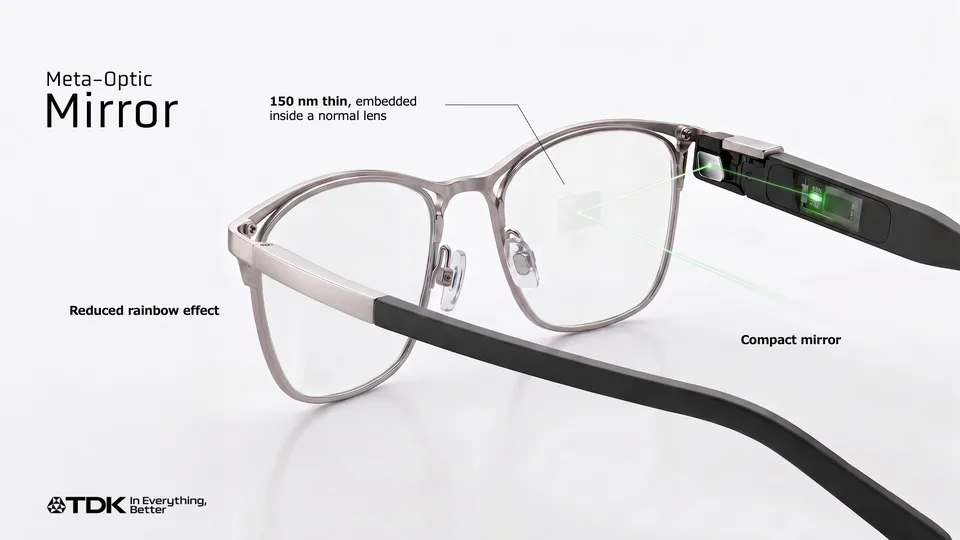
TDK says the current mirror is monochrome, and it aims for full colour and mass production within the next few years. It showed a prototype at CEATEC in October and plans to show it at electronica, November 10–13, 2026. TDK also has a business cooperation agreement with QD Laser.
Keep in mind: 150 nm is the mirror, not the glasses. Lasers, electronics and a battery still need room. There is no price, because there is nothing to buy yet.
QD Laser RETISSA: retinal projection that came first
QD Laser, based in Japan, describes its VISIRIUM technology as projecting images directly onto the retina, aimed at people who have trouble seeing. Its current product line lists RETISSA VIEWCLEAR. RETISSA displays predate TDK's 2026 mirror, so "first retinal glasses" claims deserve care.
QD Laser's site offers a contact form rather than an online store. Ask the company about the exact model, where it is sold and any medical-use status before buying.
Legato: hearing help built into the frame
Legato makes hearing glasses with the hearing technology embedded in the frame, so nothing sits in your ear. Legato says its SpeechSense feature reduces background noise, isolates speech and amplifies it.
On November 2, 2026, Legato's US store listed Aria from $1,099 and Symphony and Harmony from $999, with a 45-day money-back trial, and said the frames are HSA and FSA eligible. Check the store for current prices.
Ask before you buy: how it handles wind and crowded rooms, battery life, and whether it counts as a hearing aid where you live.
Nuance Audio: hearing glasses from EssilorLuxottica
Nuance Audio glasses come from EssilorLuxottica. The company says they are designed for adults with mild to moderate hearing loss, using directional microphones and open-ear speakers hidden in the frame. It has now introduced Nuance Audio Plus, in three frame designs and five colours, with Transitions lenses.
Nuance Audio sells through opticians rather than one global web store; its site has a store finder. Prices and any insurance cover differ by country.
Hearview: captions instead of volume
Hearview takes a different route: it turns speech into subtitles you read in the lens, instead of making sound louder. On November 2, 2026, Hearview's site listed Hearview Lite subtitle glasses at $399 as a Black Friday offer, saying they support more than 140 languages and weigh about 28 g. It also listed MYVU Air at $419, with 13 languages.
Caption accuracy depends on microphones, the language, the room and often a phone connection. Check the store for current prices and which countries it ships to.
Rokid: one name, two very different products
Rokid Glasses have a display: Rokid says it is a dual-eye, 1,500-nit Micro-LED display for translations, directions and teleprompter text, next to a 12MP camera. Rokid Style has no display. It focuses on a 12MP Sony camera, open-ear audio and a voice assistant, and Rokid lists it at 38.5 g.
On November 2, 2026, Rokid's global store listed Style at $329 (shown against $399), and its display glasses at $699 (sold out at that listing) and $619 at an EU listing. Rokid's shipping policy lists rates for the EU, UK and Australia, and a rest-of-world process. Check the store at checkout for your country.
RayNeo: from a small overlay to a big screen
RayNeo, which is part of TCL, sells several kinds of glasses under one brand. RayNeo iO is a light 33 g pair with a display for its assistant, and X3 Pro is its higher-end AR model. Air 4 Pro, GT and GT Max are mainly video displays you connect to a phone, laptop or console.
On November 2, 2026, RayNeo's EU store listed iO from €549, X3 Pro at €1,399, Air 4 Pro at €339, GT at €369 and GT Max at €489. Check the store, and don't assume EU prices apply elsewhere.
Even Realities G2: a quiet heads-up display
Even Realities calls Even G2 "the everyday display smart glasses". The company says it has a 3D heads-up display that stays out of the way until needed, can be controlled with its Even R1 accessory, and runs apps from its Even Hub developer community.

It suits people who want private reminders, notes or captions rather than photos. Check the Even Realities store for current models, prices and countries.
Solos AirGo V2: a camera on a modular frame
Solos launched AirGo V2 at CES 2026, from $299. The company says it has a 16MP stabilized camera, a SmartHinge frame you can swap, its SolosChat assistant platform with several AI models, a developer SDK and Envision accessibility features.
Why it matters: the swappable frame and the developer kit set it apart more than the camera alone. Check the Solos store for the configuration and region.
Ray-Ban Meta: the mass-market pair
Meta's glasses are the most widely sold here. In September 2026, Meta said Ray-Ban Meta Gen 3 offers up to 9 hours of battery, and that Meta glasses are available in Singapore, South Korea, Mexico and the UAE and "coming soon" to Brazil. Features such as live translation and the camera differ by model and country.
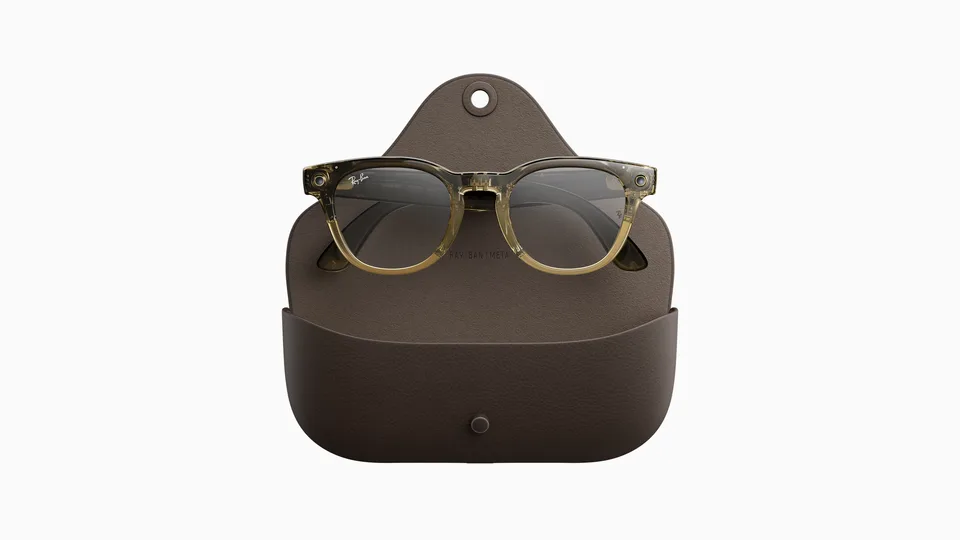
Meta launched Ray-Ban Meta Gen 2 in Brazil in September 2025 from R$3,299, and in Japan in May 2026 from ¥73,700. Check the Ray-Ban or Meta store in your country for current prices.
Ask before you buy: when the camera is recording, how others can tell, and what gets sent to the cloud.
XREAL display glasses: a big screen you plug in
XREAL 1S, One Pro and 1 Pro+ connect to a phone, laptop or console and show a large virtual screen. They are for films, games and work, not for recognising the world around you.

On November 2, 2026, XREAL's EU store listed 1S at €469 (shown against €499), One Pro at €689 and 1 Pro+ at €649. Check the store for current prices.
VITURE: another take on the personal screen
VITURE also makes display glasses that connect to your devices. On November 2, 2026, its US store listed Luma at $399, Luma Pro at $499, The Beast at $549 and Luma Ultra at $599.

Display glasses from VITURE, XREAL and RayNeo look alike but differ in field of view, tracking, device support and prescription options. Check that your phone or laptop supports video over USB-C before buying.
XREAL AURA: Android XR on transparent glasses
On October 28, 2026, Google described XREAL AURA as the first wired Android XR glasses. Google says they have transparent lenses, a 70° field of view and weigh under 95 g, and that a cable connects them to a compute puck holding the battery and a Snapdragon chip. They run Android XR apps and Gemini.

Orders opened in the US, Canada and South Korea on October 28, and in Japan on November 2. Google says the price starts at $1,099 through the end of the year, with US orders also through Best Buy and shipping from mid-November. On November 2, XREAL's site listed the 12GB/256GB model at $1,099 (shown against $1,279) and 16GB/512GB at $1,299. Check the store.
Why it matters: the app platform may matter more than the optics. Opening orders is also not the same as units in people's hands.
Where you can order
| Region | Routes the companies list | Not established |
|---|---|---|
| United States | XREAL AURA, Subvocal preorder, Legato, Hearview, Rokid, Solos, VITURE, Ray-Ban Meta | Firm ship dates for preorders |
| European Union | RayNeo EU store, XREAL EU store, Rokid shipping, Ray-Ban Meta, Nuance Audio opticians | Subvocal, AURA, TDK |
| South America | Ray-Ban Meta in Brazil; others only via international checkout | Official stores in most countries |
| Asia | XREAL AURA in Korea and Japan; Ray-Ban Meta in Japan, Singapore and Korea; QD Laser in Japan | Every model in every country |
A local web page is not proof a product ships to you. Check checkout, taxes, warranty and returns.
Five questions before you buy
- Display: does it really have one, or is it audio and camera only?
- Processing: what happens on the glasses, and what goes to the cloud?
- Language: do captions and translation work in your languages?
- Lenses: can it take your prescription, and can you still return it?
- Support: who repairs it, and how long will it get updates?
The bottom line
The glasses frame is becoming home to three things: private input, private output and an assistant that sees what you see. The winners won't be the pairs with the longest spec sheets. They will be the ones you can wear for hours, with software that works and a maker that still answers after launch day.
We have invited the companies mentioned to answer a few questions; replies will be added here.
Sources
- Subvocal, preorder page
- Y Combinator, The Subvocal Company
- Digital Trends, Subvocal's glasses (report)
- TDK, meta-optic mirror press release (Oct 2, 2026)
- TDK, meta-optic mirror feature story
- QD Laser, company site
- Legato, hearing glasses store
- Nuance Audio, hearing glasses
- Hearview, subtitle glasses
- Rokid, global store: glasses
- Rokid, AI Glasses Style
- Rokid, shipping policy
- RayNeo, EU store: AI glasses
- RayNeo, EU store: Air series
- Even Realities, Even G2
- Solos, AirGo V2 launch
- Meta, 2026 glasses line-up (Portuguese, Sep 2026)
- Meta, Ray-Ban Meta Gen 2 in Brazil (Sep 2025)
- Meta, Ray-Ban Meta launch in Japan (May 2026)
- XREAL, EU store
- VITURE, store
- Google, XREAL AURA announcement (Oct 28, 2026)
- XREAL, AURA order page
Product details are based on manufacturer announcements and store pages as of November 2, 2026, not hands-on testing. No sponsored links. See our disclaimer.