
Power banks: pick the job first, then the battery
A power bank only helps if it's in your bag when the phone hits 10%. So the first question isn't "which one is best?" It's "what do I need to charge, for how long, and how much am I willing to carry?"
One honest note before the picks. We haven't tested these ourselves. Specs are the makers' own figures and prices are what their stores showed on October 28, 2026. Where an independent lab test exists, we say so.
Quick picks
- Lightest emergency top-up: Nitecore NB Air. 89g, 19.4Wh, 18W USB-C, waterproof (IPX7). No wireless.
- Everyday phone pack: Anker Zolo A1688. 10,000mAh, built-in cable, 30W, €29.99. Or the INIU Pocket Rocket P50-E1 if you want up to 45W from one USB-C port in a small block.
- Slim magnetic wireless: Anker Nano 5K MagGo Slim (A1665). 122g, 15W wireless, 20W wired.
- Laptop on a budget: UGREEN Nexode 145W. 90Wh, 513g, €69.99.
- Laptop plus everything else: Anker Prime 26K 300W. 99.75Wh, 600g, €208.99.
- Outdoors: Goal Zero Venture35. IP67 and a real 50-lumen flashlight, $69.95 in the US store.
- Phone video with storage: ADATA SR800, a magnetic battery with a 1TB or 2TB SSD that slots into it. Stock was unclear.
| Photo | Pick | Best for |
|---|---|---|
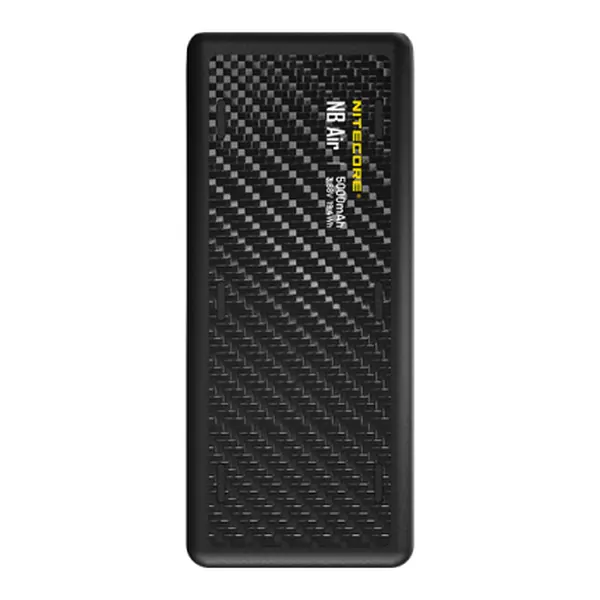 |
Nitecore NB Air Image: Nitecore |
Lightest emergency top-up |
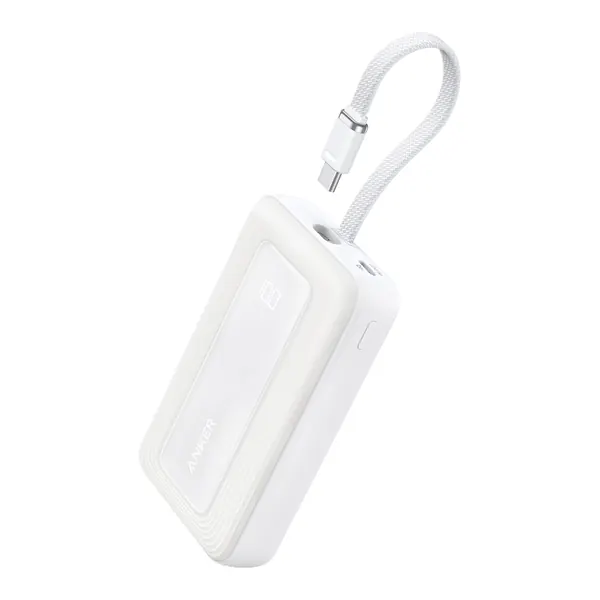 |
Anker Zolo A1688 Image: Anker |
Everyday phone pack |
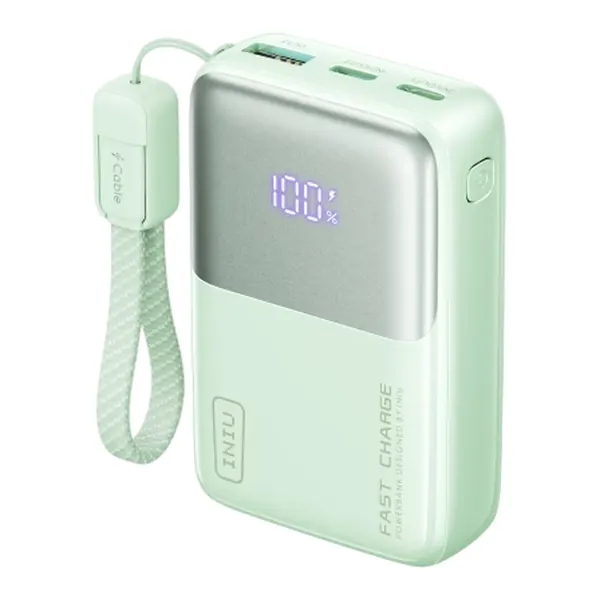 |
INIU Pocket Rocket P50-E1 Image: INIU |
Everyday pack, more power from one port |
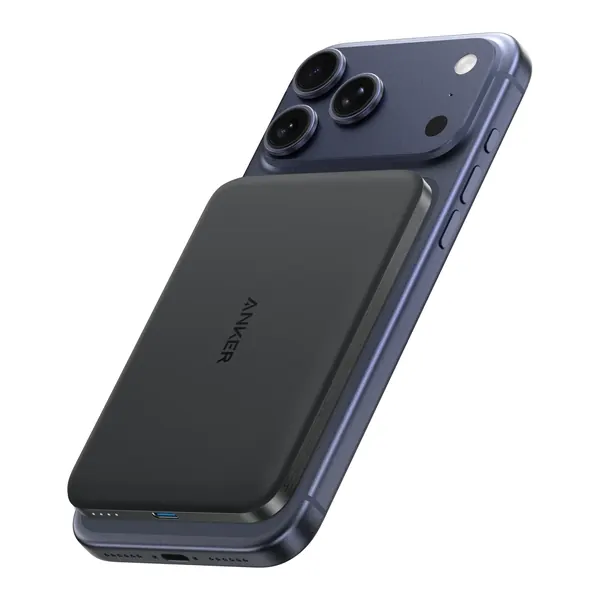 |
Anker Nano 5K MagGo Slim (A1665) Image: Anker |
Slim magnetic wireless |
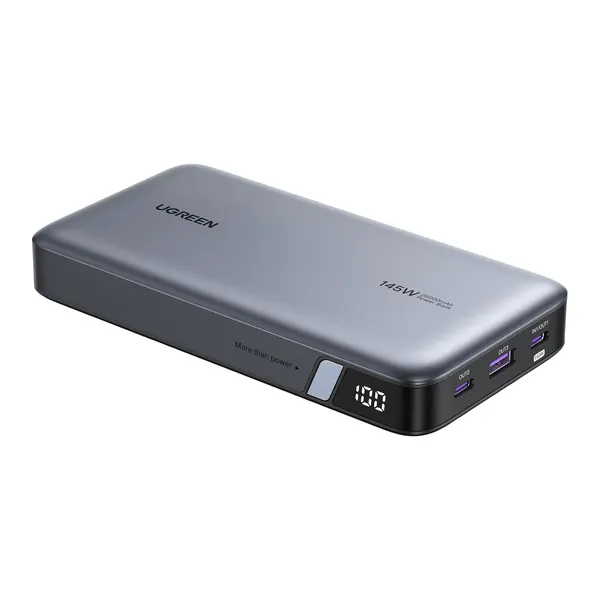 |
UGREEN Nexode 145W Image: UGREEN |
Laptop on a budget |
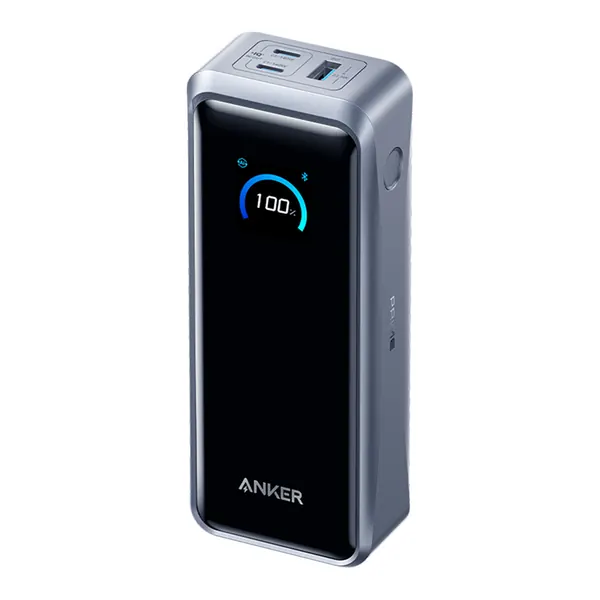 |
Anker Prime 26K 300W Image: Anker |
Laptop plus everything else |
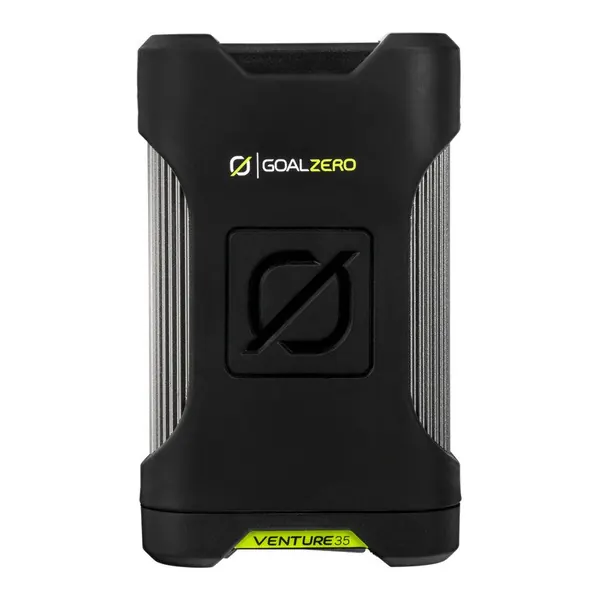 |
Goal Zero Venture35 Image: Goal Zero |
Outdoors |
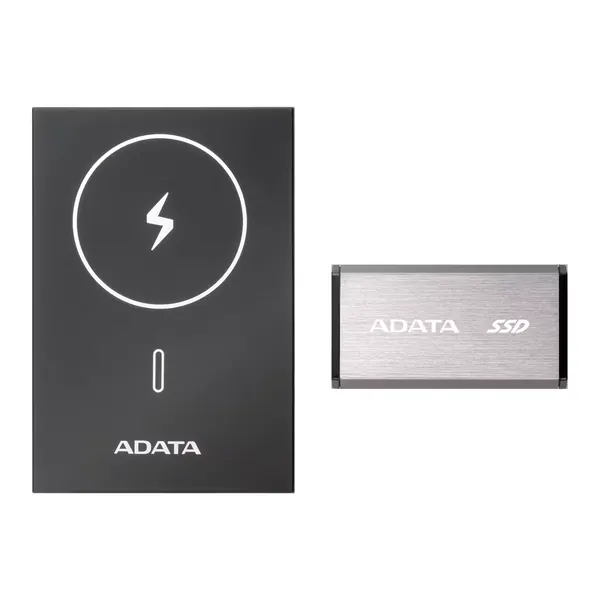 |
ADATA SR800 Image: ADATA |
Phone video with storage |
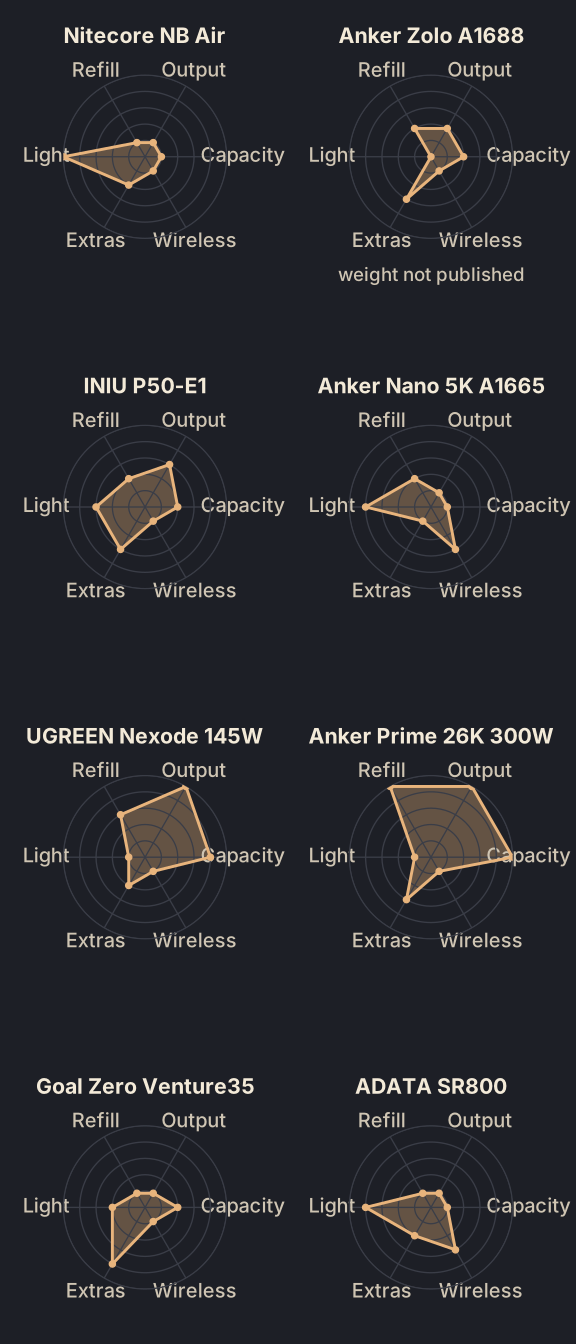
| Feature | 1 | 2 | 3 | 4 | 5 | Notes |
|---|---|---|---|---|---|---|
| Capacity (printed mAh) | ≤5,000 | ≤10,000 | ≤20,000 | ≤25,000 | >25,000 | Three makers skip Wh |
| Output (best single port) | ≤20W | ≤30W | ≤65W | ≤100W | >100W | UGREEN 140W unconfirmed |
| Refill (max input) | ≤18W | ≤30W | ≤65W | ≤100W | >100W | Needs a charger that fast |
| Light (weight) | >450g | ≤450g | ≤250g | ≤150g | ≤100g | SR800: battery only. Zolo: not published (0) |
| Extras (count) | none | 1 | 2 | 3 | 4+ | Ports, cable, water rating, light, display/app, storage |
| Wireless | none | – | up to 15W | – | faster | SR800: Qi 1.3 |
| Pick | Capacity | Output | Refill | Light | Extras | Wireless |
|---|---|---|---|---|---|---|
| Nitecore NB Air | 1 | 1 | 1 | 5 | 2 | 1 |
| Anker Zolo A1688 | 2 | 2 | 2 | n/a | 3 | 1 |
| INIU P50-E1 | 2 | 3 | 2 | 3 | 3 | 1 |
| Anker Nano 5K (A1665) | 1 | 1 | 2 | 4 | 1 | 3 |
| UGREEN Nexode 145W | 4 | 5 | 3 | 1 | 2 | 1 |
| Anker Prime 26K 300W | 5 | 5 | 5 | 1 | 3 | 1 |
| Goal Zero Venture35 | 2 | 1 | 1 | 2 | 4 | 1 |
| ADATA SR800 | 1 | 1 | 1 | 4 | 2 | 3 |
Start with the job
| Your job | Size to look at | The trade-off |
|---|---|---|
| Emergency phone top-up | 3,000–5,000mAh | Small reserve |
| Everyday phone and earbuds | 10,000mAh with USB-C PD | More pocket bulk |
| Phone plus laptop | 20,000–27,000mAh, matched to the laptop | Weight and price |
| Camping with several devices | A bigger battery or power station | Bag space, and you can't fly with the largest |
Watt-hours beat mAh
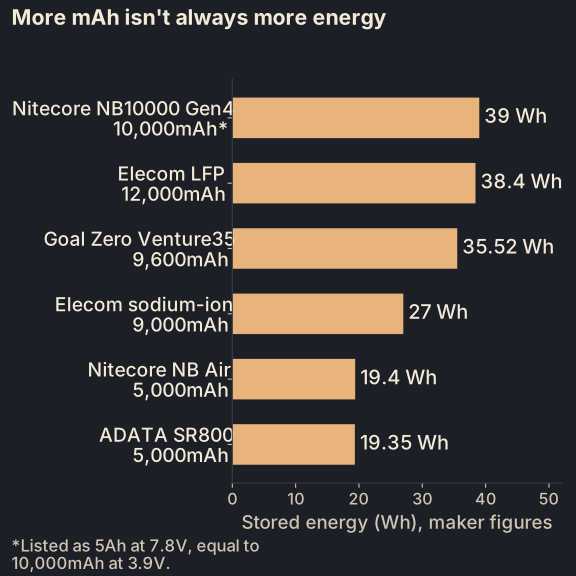
mAh on its own doesn't tell you how much energy is inside. You need the voltage too. The maths is simple: mAh × volts ÷ 1,000 = watt-hours (Wh). A 10,000mAh pack at 3.7V holds 37Wh.
Makers don't always quote the same voltage. Nitecore lists its NB10000 Gen4 as 5Ah at 7.8V. That's 39Wh, the same as 10Ah at 3.9V. Compare Wh and the confusion goes away.
Watts are speed. Watt-hours are the size of the tank. A 300W headline says nothing about how long the bank lasts.
You also never get the full tank out. The bank's electronics, the cable and the phone's own charging all turn some energy into heat. So a 10,000mAh bank won't fill a 5,000mAh phone twice. One independent home test of the NB10000 Gen4 got 34.8Wh out of the rated 39Wh at a light load, about 89%. At laptop loads, expect less.
The number nobody reads: shared output
Plug in a second device and the big number often disappears. The Zolo and the P50-E1 both drop to 15W total with two devices connected. Samsung's EB-P3401 drops to 9W each. Fine overnight, poor for a quick top-up of two phones at a café.
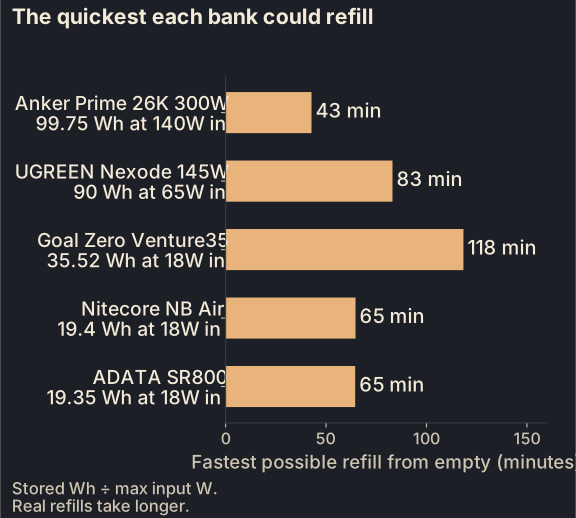
Refilling the bank matters too. A bank can't refill faster than its input allows, and only if your wall charger can keep up. A 74Wh bank that takes 30W needs at least two and a half hours from empty, and longer in real life.
Thin, light and magnetic
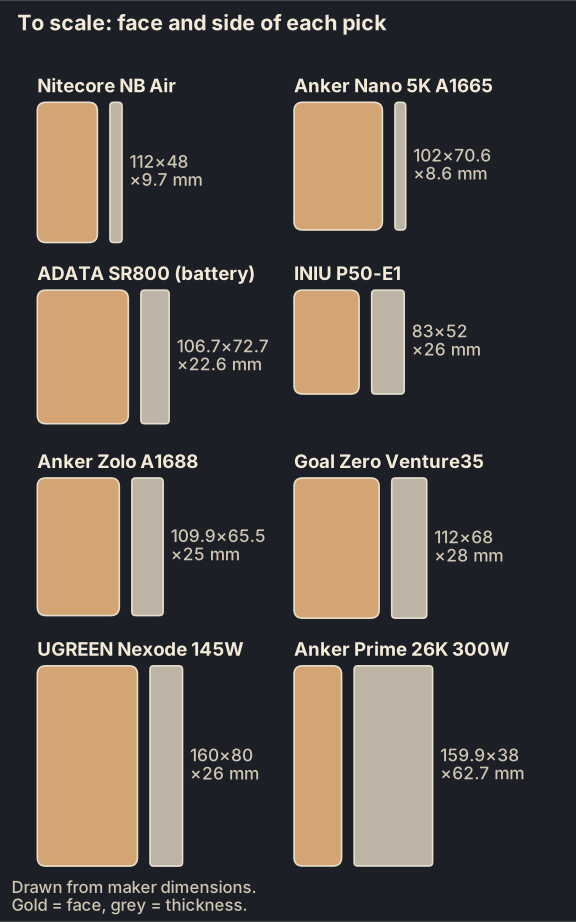
Thin and light are different contests. Elecom's DE-C94-3000BK is just 6.2mm thick and weighs 85g, but holds only 10.8Wh. It's sold in Japan. The NB Air is 4g heavier and holds almost twice the energy.
Magnets don't have to mean wireless. Nitecore's POCKET 5 snaps onto the phone and charges through a short built-in cable, which wastes less energy than wireless.
Qi2 isn't one speed. Original Qi2 and Qi2 25W are different tiers, and a magnet ring proves neither. Match the bank, the phone and the case.
Check the exact version of the A1665 you're buying. Anker's UK page lists 7.6mm in one place and 8.6mm in another. A teardown of a China-market unit found a label rated for 7.5W wireless, not 15W.
And don't squeeze a battery inside a soft phone case. A bendy case doesn't make the battery bendy, and there's no room for heat. Use a pack that attaches outside the case, or a case built around a battery.
Laptops: watts that last
Big watts don't mean a big tank. The CUKTECH 10 and Xiaomi's 165W 10K both promise high power but hold only about 36Wh. A 90Wh pack holds two and a half times as much.
The bank, the laptop and the cable all have to agree on a USB-C power level. Labels can mislead here. A teardown of the CUKTECH 15 Air found its "100W" label didn't mean 100W to a laptop. Its standard laptop output topped out at 65W.
Then check how long the power lasts. In one lab test, the Anker Prime started at 280W and fell to 100W after 13 minutes, then 60W after 23. It held a steady 100W and delivered about 90Wh. Another lab's unit held 140W without trouble. Read 300W as a peak shared across ports, not something it holds until empty.
The UGREEN 145W lists 140W on one port, but its protocol description doesn't back that up. Plan on less until you see it on your laptop. It refills at 65W.
Extras: only if you'd carry them anyway
A real flashlight, like the Venture35's, is handy in a tent or a power cut.
A built-in cable is one less thing to forget, but it can wear out. A spare port keeps the bank useful if it does. Nitecore's POCKET10000 has both.
Cooling is the new trick. UGREEN's MagFlow Pro 10K pumps liquid coolant past the charging coil (€119.99). There's no independent test yet showing it delivers more energy to your phone.
For storage, check what's actually in the box. The ADATA SR800 has a 19.35Wh battery plus an SSD, and wired and wireless charging share 15W total. It listed at $173.99 in ADATA's US store, but the page showed "low stock" and "sold out" at the same time. SHARGE's Disk Plus looks similar but has no battery, and the SSD isn't included.
New battery types: interesting, not proven
- LFP (lithium iron phosphate) is still lithium-ion. Elecom's 38.4Wh LFP pack weighs 310g, heavy for its size.
- Sodium-ion is real. Elecom sells one, but the maker says you can't take it on a plane at all, cabin or hold.
- Semi-solid packs, like Belkin's BoostSolid range, are on sale in the US since September. Semi-solid still means some liquid inside. Belkin describes a gel layer alongside liquid electrolyte.
None of these has long-term independent tests yet. Several more are only preorders. If you need a bank for a trip next week, buy one that's already shipping.
Flying with one
New international rules took effect on March 27, 2026. In the UK version: power banks go in carry-on only, each protected against short circuits, at most two per person. You can't recharge the bank on board, and you shouldn't use it to charge other devices. Up to 100Wh is fine without approval. Between 100 and 160Wh needs the airline's OK.
Airlines can be stricter. Emirates allows one bank, up to 100Wh, and no use on board. The 100–160Wh approval route is also set to go in the 2027 rules. For travel, stay at 100Wh or under, and check every airline on the trip.
Check for recalls
In September 2025 Anker recalled models A1647, A1652, A1257, A1681 and A1689 in the US. If you own one, check the serial number on Anker's recall page. It's not every Anker bank, and other brands aren't automatically safer.
What to look for
- Wh on the label. Compare energy, not mAh.
- Output per port, and with two devices plugged in.
- Input watts, and whether your charger can supply them.
- For a laptop: a matching USB-C power level and steady output, not just a peak.
- For wireless: the exact Qi2 tier, case fit and camera bump clearance.
- Weight you'll actually carry every day.
- Seller, warranty and recall status for the exact model.
Our take
Most people should start with a plain wired 10K pack like the Zolo. If it keeps staying home, go lighter with the NB Air. Laptop users get the most for the money from the UGREEN 145W, and only need the Prime when several hungry devices run at once.
Before buying, finish this sentence: "I need to power this device, for this long, while carrying this much." The right bank usually becomes obvious.